What Is Incrementality?
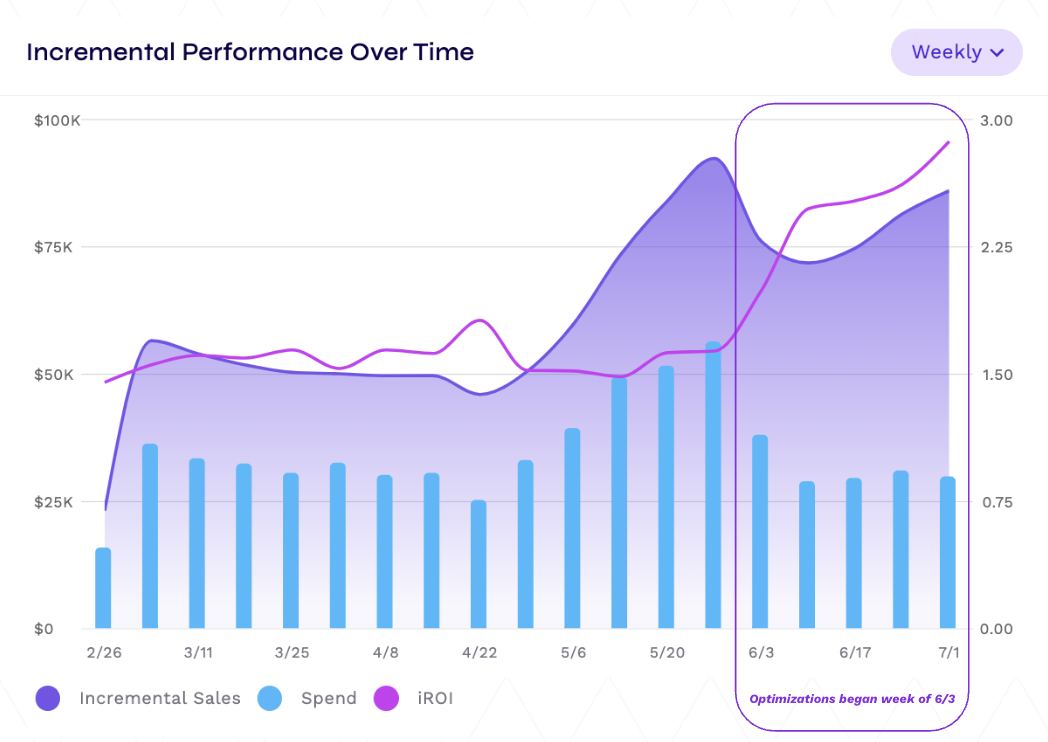
ROAS tells you what happened after someone saw your ad. Incrementality tells you whether the ad is why it happened.
That distinction sounds small. In practice, it changes everything about how brands allocate media spend.
Incrementality is the measure of true causal lift — the additional sales, revenue, or conversions that occurred because of your advertising, and would not have occurred without it. It answers a question ROAS can't: would this shopper have bought anyway?
Why the "Would Have Bought Anyway" Question Matters
Retail media has a correlation problem. Sponsored product ads target in-market shoppers — people already browsing your category, already close to a purchase decision. When those shoppers convert, the ad gets credit. But did the ad drive the sale, or did it just show up at the right moment?
This isn't a minor data quirk. It's the central flaw in how most commerce media is measured. ROAS captures attributed revenue. It doesn't isolate the revenue your ad actually caused.
The result is systematic over-attribution. Brands see strong ROAS numbers and scale spend, not realizing a significant portion of that attributed revenue was going to happen regardless. They're paying to take credit for purchases, not to drive them.
Incrementality solves this by separating correlation from causation.
How Incrementality Measurement Works
The core methodology is a controlled experiment. You split your audience into two groups: one that sees your ads (the exposed group), and one that doesn't (the holdout). The difference in purchase behavior between those two groups is your incremental lift.
This is the same logic as a clinical trial. The holdout group is your control. Without one, you don't have a result — you have an attribution story.
There are several common testing approaches:
Geo holdout tests divide geographic markets rather than individual users. You run ads in some markets, go dark in others, and measure the sales difference. This works well for retail media because purchase data maps cleanly to geography.
User-level holdouts suppress ads for a randomly selected segment of your audience and measure behavioral differences. More precise, but harder to execute cleanly across walled garden environments.
Synthetic control methods use statistical modeling to construct a counterfactual — what would have happened in a market or segment if the campaign had never run — using historical data and comparable markets as inputs. This is particularly useful when clean holdout testing isn't operationally feasible.
What all these methods share: they're asking a causal question, not a correlational one.
iROAS: The Metric That Replaces ROAS
The output of incrementality measurement is incremental ROAS, or iROAS.
Where ROAS = attributed revenue / ad spend, iROAS = incremental revenue / ad spend. It only counts the sales your advertising actually caused.
iROAS is almost always lower than reported ROAS. That's not a bug. It's accuracy. A campaign with a 6x ROAS might have an iROAS of 2.5x once you strip out the buyers who were already on their way. Knowing the real number lets you make real decisions.
High iROAS means your spend is driving genuine behavior change. Low iROAS — even alongside strong ROAS — signals you're largely fishing in a pond that was already biting.
The Halo Effect: Why Single-Retailer Measurement Misleads
One of the most underappreciated dimensions of incrementality is what happens outside the retailer where you're running ads.
When a brand runs a sponsored product campaign on a major retail media network, some of the resulting purchases happen on that network. But some happen elsewhere — on a competing retailer's site, in a physical store, or on a brand's DTC channel. If you're only measuring within-retailer ROAS, you're missing a substantial portion of the actual return.
This cross-retailer effect — often called the halo effect — is invisible in traditional retail media reporting. Incrementality measurement, when built on a unified view of sales data, can capture it. It's often the difference between a campaign that looks marginal and one that looks clearly accretive.
For CPG brands with distributed retail footprints, this matters enormously. Your media investment rarely converts in one neat channel. Measurement that pretends otherwise is leaving value on the table.
What Incrementality Measurement Requires
Getting incrementality right isn't just a methodology question. It's a data question.
You need sales data that's granular enough to detect lift, broad enough to capture the full purchase footprint, and clean enough to support causal analysis. That means matching media exposure data to purchase outcomes across retailers, time periods, and geographies — not just pulling a ROAS number from a dashboard inside a walled garden.
You also need enough scale to run statistically valid tests. Incrementality experiments require sufficient traffic and conversion volume to produce results you can trust. Small brands or thinly distributed SKUs may struggle to reach statistical significance, which is why measurement design matters as much as methodology.
The practical implication: incrementality isn't something you layer onto your existing measurement stack as a reporting tab. It requires a different data foundation and a different way of structuring your media investment decisions.
Why Brands Are Moving Toward Incrementality Now
Three things are accelerating the shift.
First, retail media has matured. The early days of retail media were about access — getting onto the network, learning the mechanics. Now brands are asking harder questions about what the spend is actually doing. ROAS hasn't kept up with the sophistication of the buyers.
Second, budgets are under pressure. In a tighter environment, "we have good ROAS" is no longer sufficient justification for a media line item. Finance teams want to know what goes away if the spend goes away. Incrementality is the only way to answer that.
Third, agentic media buying is coming. As AI-driven systems take on more of the tactical execution in commerce media, the data layer underneath those systems has to be causal, not correlational. An AI optimization engine optimizing toward attributed ROAS will make the same systematic errors at greater speed and scale. Incrementality becomes the foundation that makes intelligent automation trustworthy.
What Good Incrementality Measurement Looks Like
A few markers of a rigorous approach:
It measures across the full sales footprint, not just within a single retailer. It uses proper holdout methodology, not modeled attribution. It separates media-driven lift from organic demand and seasonal baselines. It produces iROAS at a granular enough level to inform channel, tactic, and creative decisions — not just a portfolio-level number that's directionally interesting but not actionable.
And it feeds forward. Incrementality measurement shouldn't be a quarterly diagnostic. It should be continuous infrastructure — a live signal that informs how budgets get allocated in the next period, not just how last quarter's spend performed.
ROAS was a useful proxy when commerce media was simpler. It's not sufficient infrastructure for what commerce media has become.
Incrementality is.