MMM and Incrementality: Why You Need Both for Retail Media
The incrementality vs. MMM debate has become a fixture of the measurement conversation.
Vendors on both sides have had reasons to frame them as competing methodologies, and brands have been left trying to reconcile two tools that were never actually in conflict.
The real question isn't which methodology wins. It's what decision each one is designed to serve.
Two different questions
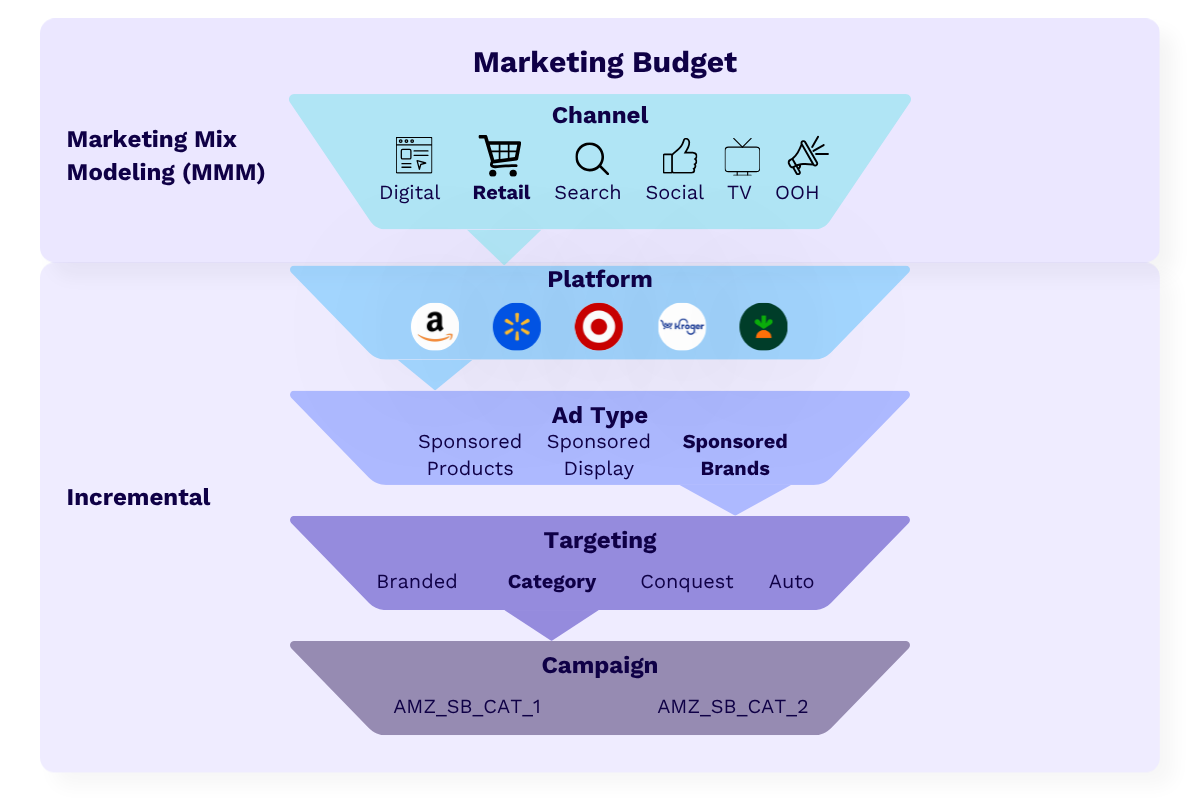
MMM exists to answer a strategic question: how should we allocate our total marketing budget across channels? It covers everything from TV, search, social, digital, and retail, and gives CMOs and Heads of Media a portfolio-level view of what's driving growth. The model runs periodically. It informs annual planning and budget cycles. It speaks the language of the C-suite.
Incrementality operates at a different altitude entirely. It answers a tactical question: is this specific campaign, at this specific retailer, generating real sales lift? It runs daily. It surfaces campaign-level signals that commerce and shopper marketing teams use to make decisions now, not next quarter.
These are different tools built for different jobs. Running one doesn't make the other redundant.
Where retail media changed the math
Before retail media became a meaningful share of brand budgets, MMM could reasonably handle most of the measurement load. The channels were fewer and decisioning was slower.
That's not the world many brands operate in today. Retail media spend has grown to the point where brands are running dozens of campaigns across multiple retailers simultaneously with different ad types, different targeting strategies, different funnel stages. The granularity MMM operates at can't keep up with the decisions commerce teams are making day to day and week to week.
That's the gap incrementality fills. Not by replacing MMM, but by going deeper where MMM can't.
MMM and incrementality run on different clocks
MMM and incrementality don't just answer different questions, they run on different clocks. MMM operates on the rhythm of planning cycles: quarterly reviews, annual budget conversations, C-suite alignment. Incrementality operates on the rhythm of retail: daily signals, campaign-level reads, in-flight adjustments.
This isn't a hierarchy. It's a handoff. MMM sets the allocation: retail media earns X% of total spend. Incrementality determines how that allocation gets deployed and whether it's working. The CMO makes the portfolio call. The commerce team executes it with daily causal intelligence telling them where to push and where to pull back.
One tool without the other leaves a gap. MMM without incrementality means optimizing retail media on channel-level averages that mask what's actually happening at the campaign level. Incrementality without MMM means winning tactically inside a budget that was set without strategic context. The stack is connective.
What this looks like in practice
A brand uses MMM to determine that retail media should represent 30% of total media spend. That decision lives with the CMO and Head of Media.
The commerce and shopper teams then use incrementality to execute against that budget – figuring out how to split it across Amazon, Walmart, Kroger, and Target, which sponsored ad formats are earning their spend, and where to pull back versus double down in real time.
Each tool is doing the job it was built for. Neither is doing the other's job poorly.
The measurement reality
Modern measurement isn't a single tool. It's a set of complementary capabilities that connect strategic allocation with daily execution. The brands getting the most out of retail media aren't treating this as an either/or. They're using both.
Ready to build a measurement stack that connects strategy to execution?
Incremental operates at the SKU and campaign level, giving commerce teams the daily causal intelligence MMM can't provide. If you're rethinking how your measurement stack fits together, get in touch.